
Engineering simulation has moved from a specialist activity, run by a few experts on expensive computers, to a standard part of product development. Today, a design engineer can run a stress analysis from inside a CAD program, an aircraft manufacturer runs millions of load cases on its structural models, and car makers crash their vehicles virtually long before they crash a real one. Why has simulation become so central? What does it offer that calculations and tests do not?
This article looks at six reasons engineers use simulation: to analyze a system over time, to explore what-if scenarios, to reduce cost and time, to visualize, to improve accuracy, and to handle uncertainties. For each one, it also looks at the conditions that must be met for the benefit to be real, because simulation brings value only when it is done well.
The three ways to solve an engineering problem
To understand the benefits of simulation, it helps to compare it with the alternatives. Engineers have three ways of predicting how a system will behave:
- Analytical methods use closed-form equations, such as beam theory, plate theory or classical formulas for stress concentrations. They are fast, give insight into the influence of each parameter, and are ideal for simple geometries and loads. But they quickly become impossible for complex shapes, materials and loads.
- Experimental methods test the real system or a scale model. They capture the real physics, including effects nobody thought to model. But they are expensive, slow, sometimes dangerous, and only possible once something has been built.
- Numerical methods, including finite element analysis, solve the equations of physics approximately for almost any geometry, material and load. They are the basis of engineering simulation.
Simulation does not replace the other two. Analytical methods remain essential to check simulation results, and tests remain essential to validate them. But simulation fills the enormous space between simple problems that can be solved by hand and expensive tests that can only be done a few times. The six benefits below explain why that space is so valuable.
1. To analyze the system in real time
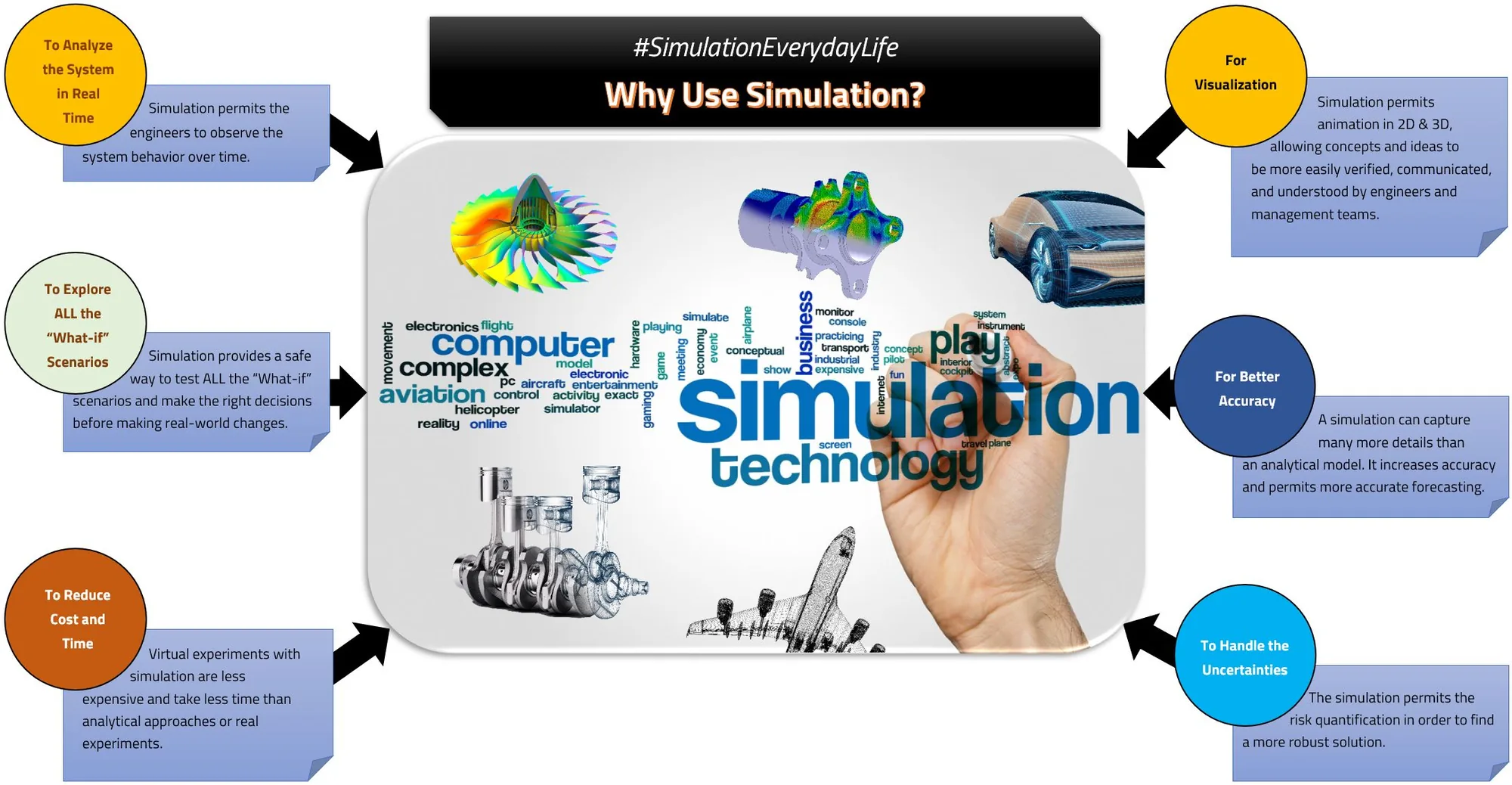
Simulation allows engineers to observe the behavior of a system over time.
Many engineering problems are not about a single state, but about how a system evolves: how a structure deforms as the load increases, how a crash unfolds over a few milliseconds, how a component heats up during operation, how a crack grows over thousands of flights. Observing this evolution in a real system is often difficult. Events can be too fast, too slow, too dangerous or happen inside the structure where no sensor can see them.
In a simulation, every instant and every point is accessible. An engineer can stop a crash simulation at any millisecond, look inside the structure, and see where the energy is absorbed. A nonlinear analysis can be followed increment by increment to see where yielding starts and how it spreads. A thermal transient can be replayed to understand when and where the peak temperature occurs.
This complete access to the behavior of the system over time is one of the main reasons simulation is used to understand failures. When a part breaks in service, a simulation of the loading history can show the sequence of events that led to the failure, which no inspection of the broken part can reveal on its own.
The condition: the time-dependent physics must be in the model. A static analysis cannot show dynamic effects, and a linear analysis cannot show the progression of yielding. Choosing the right type of analysis is the first step.
2. To explore all the "what-if" scenarios
Simulation provides a safe way to test all the "what-if" scenarios and make the right decisions before making real-world changes.
What if the load is 20 percent higher than expected? What if the material is at its minimum allowable? What if a bolt is missing? What if the temperature drops below zero? What if the supplier changes the thickness tolerance?
Each of these questions would require a separate physical test, and many could not be tested at all. In a simulation, each one is a modification of the model and a new run. Engineers can explore scenarios systematically, including extreme and accidental conditions that would be dangerous or destructive in reality.
This capacity changes the way design decisions are made. Instead of committing to a design and discovering its weaknesses during testing or in service, engineers can probe the design in a virtual environment, find its sensitivities, and make informed decisions before any real-world change. Parametric studies, design of experiments and optimization are all extensions of this idea: running many what-if scenarios in an organized way to understand and improve the design.
The condition: each scenario is only as good as the model. Exploring a hundred scenarios with an unvalidated model produces a hundred unvalidated answers. The model must first be validated for at least one representative configuration.
3. To reduce cost and time
Virtual experiments with simulation are less expensive and take less time than physical experiments.
This is the benefit most often used to justify investment in simulation, and it is real. A physical prototype can take weeks or months to build and test. Each design change requires a new prototype. Each test destroys or damages the specimen. A simulation can evaluate a design change in hours or minutes, and it can be run again and again without additional material costs.
The savings appear at several levels:
- Fewer prototypes: designs reach the prototype stage with fewer problems, so fewer iterations of physical testing are needed.
- Shorter development cycles: design decisions can be made earlier, when changes are cheap, instead of late in the program when they are expensive.
- Fewer failures in service: problems found in simulation do not become warranty claims, recalls or accidents.
- Better use of tests: tests are planned with the help of simulation, so they are more focused and more informative.
The economic argument is strongest early in development. Most of the cost of a product is committed by decisions made in the early design phases, when the cost of changing the design is still low. Simulation is the tool that informs those early decisions.
The condition: the savings depend on the quality of the analysis. A wrong simulation that leads to a bad decision can cost far more than the test it replaced. Investing in the competence of the analysts and in validation is what makes the savings real.
4. For visualization
Simulation allows animation in 2D and 3D, so that concepts and ideas can be more easily verified, communicated and understood by engineers and management teams.
A table of numbers rarely convinces anyone. A color plot of the stress distribution, an animation of a vibration mode, or a video of a crash simulation shows immediately how a structure behaves and where the problems are. Visualization is one of the most underrated benefits of simulation.
For the engineer, visualization is a verification tool. Animating the deformed shape is one of the fastest ways to detect a modeling error: a part that moves when it should be fixed, a load applied in the wrong direction, two parts that pass through each other. The human eye catches in seconds what a review of numerical output might miss.
For communication, visualization bridges the gap between specialists and non-specialists. A manager who has to decide between two designs, a customer who needs to approve a change, a production team who must understand why a fillet radius matters: all of them understand a well-chosen image or animation faster than a report full of numbers.
The condition: images can mislead as easily as they can inform. A contour plot with a poorly chosen scale, averaged stresses across a material interface, or a deformation scale factor that exaggerates a negligible displacement can create a false impression. Good visualization requires knowing what to show and how to show it honestly.
5. For better accuracy
A simulation can capture many more details than an analytical model. It increases accuracy and permits more accurate forecasting.
Analytical methods rely on simplified geometries and idealized conditions. A beam formula assumes a uniform cross-section, a plate formula assumes simple supports, a stress concentration factor comes from a chart for a standard geometry. Real parts have complex shapes, variable thicknesses, holes, fillets, multiple materials and complex load paths. Each simplification made to apply an analytical method reduces the accuracy of the prediction.
Simulation can include these details. A finite element model can represent the real geometry, the real material distribution, the real supports and the real loads, including their interactions. The result is a more detailed and, when done correctly, more accurate prediction of the behavior. This is what allows engineers to reduce safety margins with confidence, to design lighter structures, and to forecast the behavior of complex systems.
The condition: more detail does not automatically mean more accuracy. Each added detail requires correct data and correct modeling, and a detailed model built on poor data or wrong assumptions can be less accurate than a simple hand calculation. That is why analytical estimates remain essential: they provide a check on the order of magnitude of every simulation result.
6. To handle the uncertainties
Simulation permits the quantification of risk in order to find a more robust solution.
Real-world inputs are uncertain. Material properties scatter from batch to batch, dimensions vary within their tolerances, loads vary with operating conditions, and boundary conditions are never exactly known. A design that works perfectly for nominal values may fail when several unfavorable variations combine.
Simulation makes it possible to study these uncertainties systematically. Sensitivity studies show which inputs have the most influence on the result. Probabilistic methods, such as Monte Carlo simulation, propagate the scatter of the inputs to the outputs and estimate the probability of failure. Robust design methods search for designs whose performance is insensitive to variations.
The result is a better understanding of risk. Instead of a single answer, the engineer obtains a range of possible outcomes and their likelihood, which allows informed decisions about safety factors, tolerances, inspections and testing. This is particularly valuable in industries where the consequences of failure are severe, such as aerospace, nuclear, medical devices and automotive safety.
The condition: uncertainty quantification requires statistical data on the inputs and many simulation runs. It also requires a model that is validated over the range of variations studied. It is a demanding activity, but it is the most honest way to answer the question "how safe is this design?"
What simulation does not do
The six benefits above are real, but they come with limits that every engineer should keep in mind.
- Simulation does not replace engineering judgment. The software solves the model it is given. It does not know whether the model represents reality.
- Simulation does not eliminate testing. Validation against tests is what makes simulation trustworthy. The goal is better and fewer tests, not no tests.
- Simulation does not produce certainty. Every result carries the uncertainties of its data, its assumptions and its method.
- Simulation does not make errors visible by itself. A wrong model can produce smooth, colorful, convincing results. Only checks, comparisons and experience reveal the errors.
These limits are not reasons to avoid simulation. They are reasons to do it well: to invest in the competence of the people who perform it, to follow a structured process, and to validate the models before relying on them.
Conclusion
Engineers use simulation because it gives them a laboratory where any system can be built, loaded, observed and changed at low cost. It allows them to analyze behavior over time, explore what-if scenarios safely, reduce development cost and time, visualize and communicate complex behavior, capture details that analytical methods cannot, and quantify the uncertainties that determine the real safety of a design.
Each of these benefits depends on the same foundation: a sound model, reliable data, conscious assumptions and rigorous validation. When that foundation is in place, simulation is one of the most powerful tools in engineering. To understand what lies behind a simulation in the first place, read What Is Simulation?, and to see how simulation is carried out with the finite element method, read The FEA Process.
Go further
Learn FEA with a structured path: the on-demand course Practical Basic FEA covers the fundamentals step by step, and Practical Finite Element Analysis for Mechanical Engineers by Dominique Madier gathers the best modeling practices in one book.
See the Practical Basic FEA course Take the free FEA diagnostic