
When engineers start learning finite element analysis, they often see it as a single skill: you either "know FEA" or you do not. In reality, structural FEA is a whole field made of many domains, each with its own physics, its own modeling techniques and its own pitfalls. An engineer who is an expert in linear static analysis of aircraft structures can be a beginner in crash simulation. A specialist in nonlinear material behavior may never have run a topology optimization. Knowing where you stand, and where you need to go, requires a map.
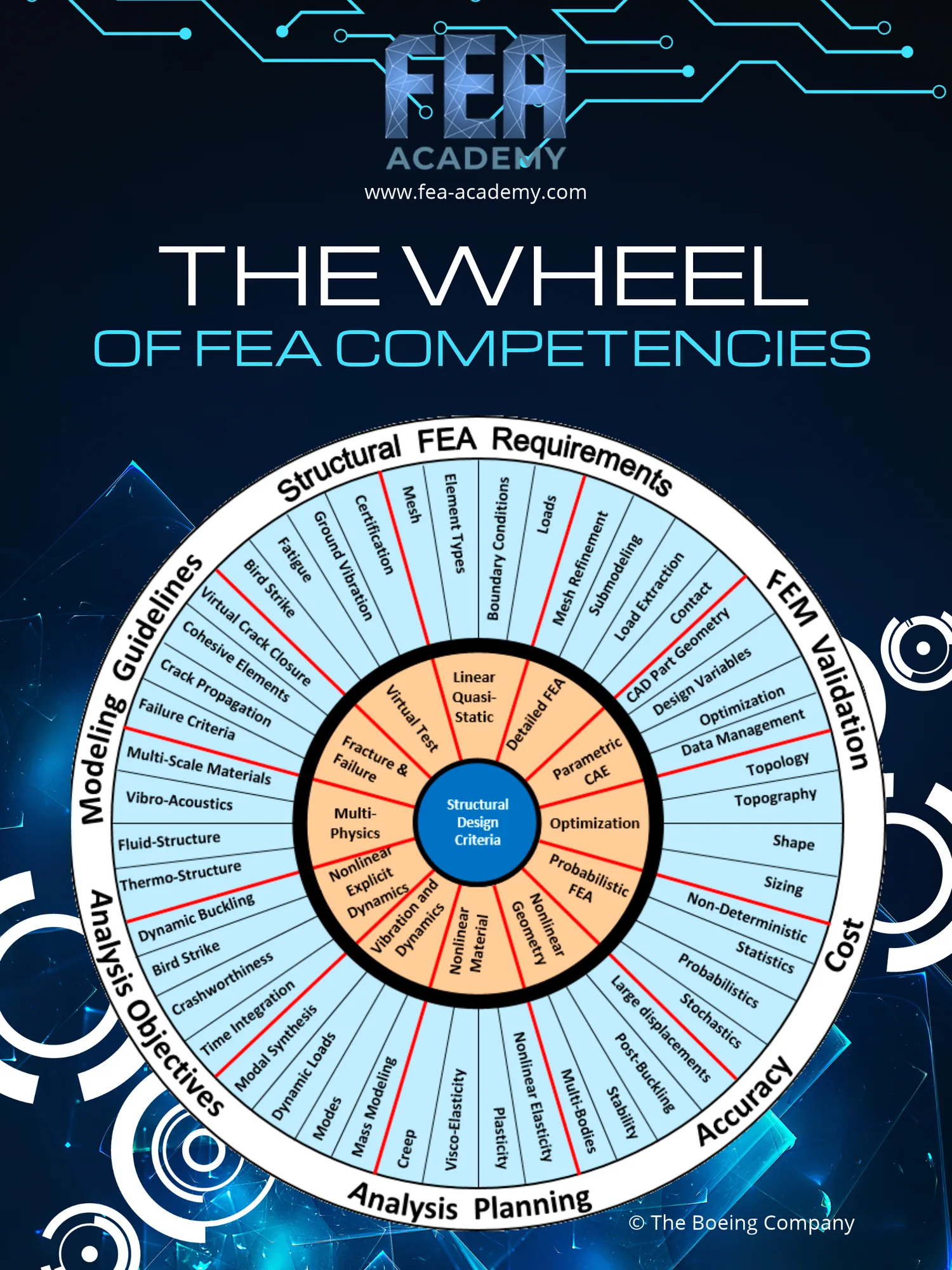
The wheel of FEA competencies is such a map. It was developed by The Boeing Company to describe the competencies involved in structural finite element analysis, and it organizes them in concentric rings around a single objective: meeting the structural design criteria. This article explains how the wheel is built, describes each of its twelve domains and forty-eight competencies, and shows how you can use it to assess your skills and plan your learning.
How the wheel is built
The wheel has four levels, read from the center outward.
The center: structural design criteria. Everything in structural FEA serves one purpose: demonstrating that a structure meets its design criteria. These criteria include strength, stiffness, stability, fatigue and damage tolerance, crashworthiness and many others, depending on the industry. The analysis is not the goal; it is the means of showing that the structure will do its job safely. Placing the design criteria at the center is a reminder that every competency on the wheel exists to answer an engineering question.
The inner ring: twelve analysis domains. Around the center, the orange ring divides structural FEA into twelve domains: linear quasi-static, detailed FEA, parametric CAE, optimization, probabilistic FEA, nonlinear geometry, nonlinear material, vibration and dynamics, nonlinear explicit dynamics, multi-physics, fracture and failure, and virtual test.
The middle ring: forty-eight competencies. Each domain is divided into four specific competencies, shown in the light blue ring and separated by red lines between domains. These are the skills that an analyst needs to master within each domain.
The outer ring: the cross-cutting dimensions. The white outer ring lists seven dimensions that apply to every domain: structural FEA requirements, FEM validation, cost, accuracy, analysis planning, analysis objectives and modeling guidelines. Whatever the domain, the analyst must plan the analysis, define its objectives, follow modeling guidelines, control its cost, ensure its accuracy, validate the model and satisfy the requirements.
The structure of the wheel carries an important message: depth in one domain is not enough. A competent analyst needs a solid foundation in the core domains, awareness of the others, and mastery of the cross-cutting dimensions in all of them.
The foundation domains
Linear quasi-static
This is where every structural analyst starts, and where most structural analyses are still performed. Its four competencies are the fundamentals of FEA:
- Mesh: creating a mesh with the right density and quality for the results of interest.
- Element types: choosing between beam, shell and solid elements, and between first- and second-order formulations.
- Boundary conditions: representing supports realistically, without over- or under-constraining the model.
- Loads: applying forces, pressures, accelerations and thermal loads that represent the real load introduction.
These four competencies are not "beginner" skills that you leave behind. They are used in every other domain of the wheel. A crash simulation with poor boundary conditions is as wrong as a linear static analysis with poor boundary conditions; it just takes longer to find out.
Detailed FEA
Large structures are often analyzed with a global finite element model (GFEM) that captures the load paths but is too coarse for detailed stress analysis. The detailed FEA domain covers the techniques used to go from the global picture to accurate local results:
- Mesh refinement: increasing the mesh density in critical areas, and checking convergence.
- Submodeling: creating a detailed local model driven by the displacements or forces of the global model.
- Load extraction: extracting internal loads, such as element forces, grid point forces and free body diagrams, from the global model for detailed hand calculations or local models.
- Contact: modeling the interaction between parts that can touch, slide or separate.
These competencies are central in industries such as aerospace, where the stress analysis of a large structure combines a global model, detailed models of critical regions and classical stress methods applied to the extracted loads.
Design-driven domains
Parametric CAE
Parametric CAE connects analysis to design. Instead of analyzing one fixed geometry, the analyst works with a model driven by parameters that can be changed automatically:
- CAD part geometry: working with the CAD model as the source of geometry, and maintaining the link between design and analysis.
- Design variables: defining the parameters that can change, such as thicknesses, dimensions or material choices.
- Optimization: using the parametric model to search for better designs.
- Data management: organizing the models, versions, parameters and results generated by many analyses.
This domain is increasingly important as design cycles become shorter and more analyses are run per project.
Optimization
The optimization domain covers the formal techniques used to find the best design within a set of constraints:
- Topology: finding the best distribution of material within a design space.
- Topography: finding the best pattern of beads and reinforcements in a shell structure.
- Shape: modifying the boundaries of a part to reduce stress concentrations or weight.
- Sizing: optimizing parameters such as thicknesses and cross-sectional properties.
Optimization is powerful, but it amplifies the weaknesses of the model. An optimizer will find and exploit any error in the boundary conditions or loads. That is why optimization sits on the wheel next to competencies that ensure the model is right.
Probabilistic FEA
Most analyses are deterministic: one geometry, one set of material properties, one load. Real structures are not. Dimensions vary within tolerances, material properties scatter, and loads are uncertain. The probabilistic FEA domain addresses this variability:
- Non-deterministic methods treat inputs as variables rather than fixed values.
- Statistics provide the tools to describe the scatter of inputs and outputs.
- Probabilistics estimate the probability of failure or of exceeding a limit.
- Stochastics deal with random processes, such as random vibration or random fields of material properties.
Probabilistic methods allow engineers to quantify the reliability of a design and to understand which uncertainties matter most.
Nonlinear and dynamic domains
Nonlinear geometry
When displacements or rotations become large, the stiffness of the structure changes with its deformation, and linear analysis is no longer valid. The nonlinear geometry domain includes:
- Large displacements: accounting for the change of geometry in the equilibrium equations.
- Post-buckling: following the behavior of a structure after it buckles, which is essential for thin-walled structures designed to carry load beyond initial buckling.
- Stability: predicting buckling loads and collapse, including the effect of imperfections.
- Multi-bodies: analyzing mechanisms and assemblies with large relative motions between parts.
Nonlinear material
When the material behavior is not linear elastic, a different set of competencies is needed:
- Nonlinear elasticity: materials such as elastomers that return to their original shape but with a nonlinear stress-strain relationship.
- Plasticity: permanent deformation of metals beyond yield, with hardening rules and failure criteria.
- Visco-elasticity: time-dependent behavior of polymers and other materials whose response depends on the loading rate.
- Creep: slow deformation under sustained load, typically at high temperatures.
Nonlinear material analyses depend heavily on the quality of the material data, which must be measured, fitted and validated with care.
Vibration and dynamics
Structures that are subjected to time-varying loads require dynamic analysis. The domain includes:
- Mass modeling: representing the mass and inertia of the structure and its equipment correctly, which controls the natural frequencies.
- Modes: computing natural frequencies and mode shapes, the foundation of all dynamic analysis.
- Dynamic loads: defining time-varying, harmonic, random and shock loads.
- Modal synthesis: combining modes, and reduced models of substructures, to compute the dynamic response of large structures efficiently.
Nonlinear explicit dynamics
Some events are so fast and so violent that implicit methods are not practical. Explicit dynamics solves the equations of motion in very small time steps, and is used for impacts, crashes and other short-duration events:
- Time integration: understanding explicit time integration, stability limits and mass scaling.
- Crashworthiness: predicting the behavior of structures in crashes, and their ability to protect occupants.
- Bird strike: simulating the impact of birds on aircraft structures such as leading edges, windshields and engine fan blades.
- Dynamic buckling: predicting buckling under rapidly applied loads.
Coupled and failure domains
Multi-physics
Many structural problems involve other physics. The multi-physics domain covers the main couplings:
- Thermo-structure: thermal stresses and the effect of temperature on material properties.
- Fluid-structure: interaction between structures and fluids, from aeroelasticity to sloshing.
- Vibro-acoustics: coupling between structural vibration and sound.
- Multi-scale materials: linking the behavior of the material at the micro scale, for example fibers and matrix in a composite, to the structural scale.
Fracture and failure
Predicting how and when a structure fails is one of the most demanding tasks in FEA. The domain includes:
- Failure criteria: applying criteria for yielding, rupture and composite failure.
- Crack propagation: predicting the growth of cracks under static or cyclic loads.
- Cohesive elements: modeling delamination and the separation of bonded interfaces.
- Virtual crack closure: computing energy release rates at crack fronts, a key technique in damage tolerance and composite delamination analysis.
Virtual test
The last domain brings everything together. Virtual testing uses simulation to reproduce, complement and sometimes replace physical tests:
- Bird strike: here as a certification test that can be supported by simulation.
- Fatigue: predicting the fatigue life of structures under service loads.
- Ground vibration: reproducing the ground vibration test performed on aircraft to identify their modes.
- Certification: using validated simulation as part of the evidence for certification, sometimes called certification by analysis.
Virtual testing requires the highest level of confidence in the models, which is why it depends on all the other domains and on rigorous validation.
The outer ring: what applies to every domain
The seven dimensions of the outer ring are easy to overlook, because they are not specific techniques. Yet they distinguish a competent analyst from someone who knows how to operate the software.
- Structural FEA requirements: knowing which requirements the analysis must satisfy, from customer specifications to regulations.
- Analysis objectives: defining clearly what the analysis must answer.
- Analysis planning: organizing the analysis, its load cases, its models and its schedule.
- Modeling guidelines: following documented best practices, so that models are consistent, reviewable and reliable.
- Accuracy: controlling the errors of the model, through verification, convergence and checks.
- FEM validation: comparing the model with tests or reference solutions.
- Cost: balancing the level of detail, the computing time and the engineering time against the value of the answer.
These dimensions form the professional framework of FEA. In many organizations, they are captured in standard operating procedures, modeling guidelines and review processes.
How to use the wheel
The wheel is more than a classification. It is a practical tool for engineers, managers and educators.
For engineers: assess your skills
Go through the forty-eight competencies and rate yourself on each one, for example from 0 (no knowledge) to 3 (can perform independently and teach others). The result is a profile that shows where you are strong, where you have gaps, and which domains you have not explored. Most engineers find that their profile reflects their industry and their job history more than a deliberate learning path.
For managers: build balanced teams
A team does not need every engineer to master every domain. It needs the domains that matter for its products to be covered, with enough depth and enough redundancy. Mapping the team on the wheel shows where expertise is concentrated in a single person, where competencies are missing, and where training or recruitment would have the most impact.
For learning: follow a logical path
The wheel also suggests a learning path. The foundation, linear quasi-static and detailed FEA, comes first, because its competencies are used everywhere else. Vibration and dynamics, and nonlinear geometry and material, come next for most structural analysts. The more specialized domains, such as explicit dynamics, multi-physics, probabilistic FEA and fracture, build on these foundations. The cross-cutting dimensions of the outer ring should be developed from the start, because good habits in planning, accuracy and validation are much easier to build early than to correct later.
| Stage | Domains | Typical focus |
|---|---|---|
| Foundation | Linear quasi-static, detailed FEA | Elements, mesh, boundary conditions, loads, submodeling, load extraction |
| Core extension | Vibration and dynamics, nonlinear geometry, nonlinear material | Modes, dynamic loads, large displacements, buckling, plasticity |
| Specialization | Explicit dynamics, multi-physics, fracture and failure | Impact, coupled physics, crack growth and delamination |
| Design and reliability | Parametric CAE, optimization, probabilistic FEA | Design variables, optimization methods, uncertainty |
| Integration | Virtual test | Correlation, certification support |
Conclusion
The wheel of FEA competencies shows that structural finite element analysis is not a single skill, but a structured set of forty-eight competencies across twelve domains, all serving the same goal: demonstrating that a structure meets its design criteria. It shows that the fundamentals of meshing, elements, boundary conditions and loads are used everywhere. And it shows that the professional dimensions of the outer ring, planning, guidelines, accuracy, validation and cost, are as important as any technique.
Whether you are starting your FEA journey or leading an analysis team, the wheel gives you a common language to discuss skills, a tool to identify gaps, and a map to plan the next step. The most effective way to use it is to start where every structural analyst starts: with a solid foundation in the core competencies, and the habits of a rigorous analyst.
Go further
Learn FEA with a structured path: the on-demand course Practical Basic FEA covers the fundamentals step by step, and Practical Finite Element Analysis for Mechanical Engineers by Dominique Madier gathers the best modeling practices in one book.
See the Practical Basic FEA course Take the free FEA diagnostic