
Most engineers learn finite element analysis the wrong way around. They open the software, follow a tutorial, click through the menus and obtain a colorful stress plot, without ever being told how to judge whether that plot is right. I learned FEA on my own, without a mentor, and I made many of the mistakes this approach produces. This article describes the learning path I recommend after more than 25 years of structural analysis: the three stages of the learning process, the main rule and the main danger of FEA, the thirteen skills an FE analyst must master, my ten guidelines for learning, and the five advantages that make the effort worthwhile.


The three stages of the FEA learning process
Learning FEA happens in three stages:
- Stage 1: learning basic FEA theory.
- Stage 2: learning proper modeling techniques.
- Stage 3: learning how to use FEA software.
Engineers typically learn FEA theory at university or college, before they learn to use FEA software. All too often, they skip Stage 2, which consists of learning proper modeling techniques. This is a serious problem: many analysts make incorrect assumptions and produce wrong analyses simply because they are unaware of the basic rules of FEA modeling.
A good knowledge of modeling techniques lets you make the right assumptions and choices to model and solve problems accurately. And once you know the theory and the modeling techniques, learning a software package is the easiest step of the whole process. The order matters: theory, then modeling, then software.
The main rule of FEA learning
Learning FEA is more than learning how to use software. It is a question of understanding the FEA process, acquiring the best modeling practices, and knowing the behavior of the system you wish to model.

Unfortunately, engineers often try to learn FEA by using the software before they understand the theory and the modeling techniques. In my view, learning FEA from a software perspective is a recipe for disaster, because FEA is not about the software. It requires an understanding of the modeling process that allows you to solve physical problems. The importance of the software itself is very often overestimated compared with a good understanding of the modeling process.
During my coaching sessions with beginners, I regularly see them focus on the graphical aspects of the software rather than on the engineering data and the modeling techniques. A clean mesh and a smooth contour plot look convincing, but they prove nothing.
Always remember that FEA software is a black box for solving very large systems of equations that cannot be solved by hand. FEA is simply a tool that helps you in your structural analyses. If you do not master the modeling techniques, you will probably submit an incorrect system of equations to the solver, and the solver will still give you a solution, even when that system of equations has nothing to do with your problem.
The main danger of FEA
The main danger of FEA is not knowing whether an answer given by the software is correct.

The software always answers the system of equations submitted by the analyst, even if that system does not represent the real problem. To address this danger, you must:
- Understand the behavior of the system you wish to model, and be able to predict that behavior before you begin modeling.
- Follow the best modeling practices.
- Use validated modeling techniques.
Above all, always trust your engineering judgment. The most important quality you need before modeling a mechanical system with FEA is not your knowledge of the menus; it is your engineering judgment.
What do you need to learn in the FEA field?
To build reliable and accurate finite element models, there are thirteen skills to acquire.
1. Define an FEA strategy
Developing a finite element model is like playing chess: you must anticipate problems, predict behavior and adapt your strategy. Anticipating potential issues when building a complex model of several connected parts is not easy, and planning is the key. Without planning, you may run into problems that you cannot solve without degrading the quality of your model. Each simulation, and each problem, calls for its own strategy.

2. Know the solutions available with your solver
Every solver offers a set of solutions: linear static, modal, buckling, nonlinear, transient and so on. Each one has capabilities and limitations, and you must know them to choose the right solution for your problem.
3. Know the library of elements of your solver
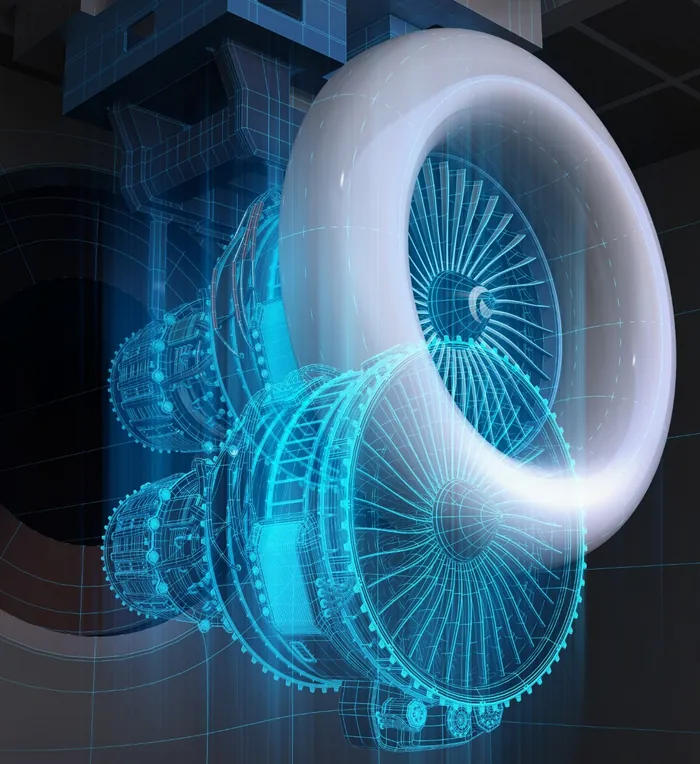
Together with the nodes, the elements are the key to discretization in FEA. The elements you choose influence the behavior of your model. This is why software publishers document the library of elements associated with their solvers, and analysts must understand the capabilities of each element to select the right one. Personally, whenever I change solvers, the first thing I do is read the documentation of the element library, to learn the capabilities and limitations of each element type.

4. Perform meshing
Meshing means creating either a global model to capture global effects or a detailed model to capture local effects. To create a discretization that is compatible with your problem, you need to learn how to:
- Define a meshing plan.
- Select the appropriate element types to represent the behavior of the structure.
- Apply the proper mesh refinement.
- Conduct a mesh convergence study.
- Create mesh transitions.
- Perform mesh quality checks.
- Choose between 1D, 2D and 3D meshing.
- Choose the element sizes.

5. Define the right boundary conditions
Defining constraints and loads is one of the most complex problems you will face as an FE analyst. Boundary conditions strongly influence the results, and the solver will give you a solution in most cases even if you choose the wrong ones. Defining the correct boundary conditions ensures that you submit to the solver the set of equations that corresponds to your problem.

6. Choose the right material models
A linear elastic material is enough for many analyses, but plasticity, hyperelasticity, creep, composites and temperature-dependent properties all require specific material models. Choosing the wrong one makes even a perfect mesh useless.

7. Make assumptions about the connections among parts
Real structures are assemblies of parts connected by bolts, rivets, welds, adhesives and contact. Each connection must be represented by a modeling assumption, and these assumptions control how loads flow from one part to another.
8. Validate and correlate your finite element model
Validation gives confidence in your results, to you, to your client and to the final users of the analysis. Methods exist to verify and validate an FEA, so learn them and use them. If you work with test data, you will also need to learn how to correlate a model with the test results and how to adjust and calibrate it.
9. Understand the outputs provided by the solver
A simulation produces a large variety of results. You must learn how to interpret them and make sure they correspond to what you are looking for. FEA packages also offer many options for extracting results, such as averaging, element versus nodal values and coordinate systems, and each option can significantly change the numbers you read.
10. Perform submodeling
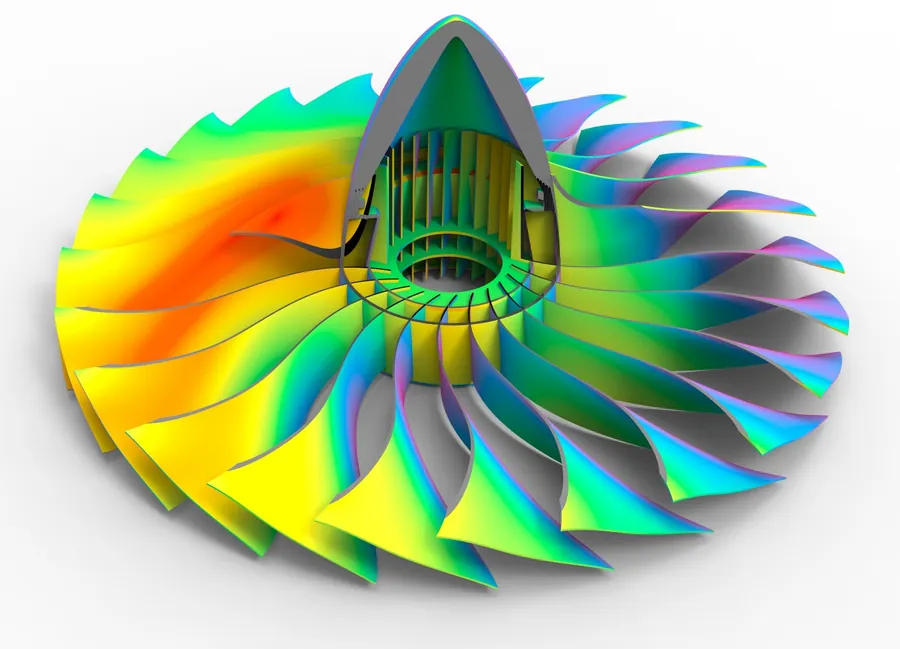
Submodeling is a technique that lets you build a very detailed analysis in a particular region of a model without refining the whole model. It is a very powerful technique, and every analyst working on large structures should master it.
11. Optimize the performance of your FE runs
Each FEA package has parameters that control the performance of a simulation, and you should learn them. I also strongly recommend learning about the architecture of the computers you use, whether a PC, a high-performance computer or a cluster, because it will help you reduce your run times.

12. Document your FEA
From an industrial point of view, an FEA and its results must remain traceable years after the project is completed. Most FEA documentation focuses mainly on the results, but those results depend on many parameters, so all the assumptions of the simulation must be documented as well. FEA documentation serves to:
- Present the assumptions made to build the simulation.
- Track the data used to perform the analysis.
- Provide a basis for further analysis.
- Allow other analysts to replicate the analysis.
- Support training.
- Establish in-house expertise in FEA.
13. Follow FEA best practices
Finally, learn and follow FEA best practices. They are the condensed experience of generations of analysts, and following them avoids most of the classic errors.
My ten guidelines for learning FEA
For a mechanical engineer, FEA is a tool well worth the effort to learn. Here are the ten guidelines I give to the engineers I coach.
1. Start with a background in the physics you wish to simulate
For the structural analysis of mechanical systems, you need a strong background in engineering mechanics, including calculus, statics, basic dynamics and the strength of materials. FEA does not replace this knowledge; it relies on it.
2. Take classes in basic FEA theory
The better you know the theory the software processes, the better you will perceive the limitations of its solutions. You will probably never develop FEA software or a new element, but learning the basic theory helps you understand four things:
- How the stiffness matrices are computed for the various element topologies.
- How the global stiffness matrix of your system is assembled.
- How the solver computes the primary variables, which are the displacements in structural analysis.
- How the solver computes the secondary variables: forces, stresses and strains.
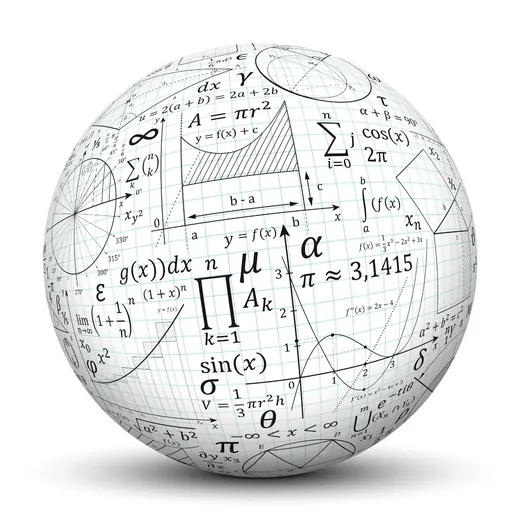
Even if you never solve the equations yourself, this knowledge will help you make the right assumptions during the modeling process.
3. Do not begin with software; learn FEA
Software lets you build and examine models, but it is dangerous to use it without understanding the underlying modeling concepts. Whatever software you use, the modeling techniques remain the same. And over the course of your career, you will probably change software packages several times. The modeling skills stay with you; the menus do not.
4. Understand the behavior of your problem
FEA is not employed to predict the behavior of your mechanical system. You must do the opposite: be able to predict the behavior of your structure in order to build a reliable and accurate model. Your engineering judgment and your ability to anticipate how the system will behave are fundamental. If you do not know roughly what to expect, you cannot recognize a wrong answer.
5. Always try to understand things in depth
At the beginning, it takes time to understand the FEA process. The return on that investment comes later: by understanding in depth what happens in one problem, you will be able to solve similar problems in the future. To understand FEA in detail, you need to go beyond the tutorials prepared by software distributors. Those tutorials typically explain where to click to obtain results. Following them, you will press the solve button and probably obtain a result without ever seeing an error message, but this approach will not make you a real-world FEA analyst.
6. Start with simple problems
It is always best to start with small, simple models. A building block approach is an efficient way to learn FEA: studying simple problems first lets you understand what is going on, so that you can eventually solve complex problems faster.

The short run time of a simple model is another advantage. If something is wrong, you will not wait long for the result or the error message, so you can fix it and iterate quickly. This speeds up your learning considerably.
7. Take FEA training classes
FEA training instructors are often specialists in the field who can share a great deal of practical knowledge. A good training class teaches much more than which buttons to push: it teaches modeling techniques you can apply to any problem, in any project, independently of the software.
8. Practice, practice, and more practice
At the end of an FEA class, a trainer once told his students: "You have two choices: practice what you have learned, or I will see you next year for a repeat of this training course!" Knowledge that is not applied fades quickly. Build models, compare them with hand calculations, and test your understanding on problems whose answers you know.
9. Join user groups and attend FEA seminars
User groups, both online and in person, are a great way to learn from your peers. I strongly believe that other people are the best source of knowledge, and many more people than you think are willing to share what they know. Attending FEA seminars and conferences, such as those organized by NAFEMS, also keeps you up to date with the latest methods and features.

10. Be patient
It takes time to learn FEA. There will be a lot of trial and error before you feel confident about what you are doing. Starting from scratch and using good resources, it usually takes about three years to acquire the basic knowledge, and about five more years to acquire the advanced knowledge. Even after eight years, you will still be learning: FEA is a field that keeps evolving.

FEA is a very powerful tool that looks incredibly simple from the outside, when in reality it is complex and there is a lot to learn. Keep in mind that FEA always provides an answer, even an incorrect one, and without strong FEA knowledge you may not recognize the inaccuracies. Think of FEA as a calculator that is difficult to use. Take your time to acquire the knowledge needed to conduct a good analysis, and you will be able to simulate and solve the engineering problems you want.
The wheel of FEA structural competencies
How wide is the field you are about to learn? The Boeing Company has summarized it in a "wheel of FEA structural competencies." At its center are the structural design criteria. Around them are the main analysis families: linear quasi-static, detailed FEA, parametric CAE, optimization, probabilistic FEA, nonlinear geometry, nonlinear material, vibration and dynamics, nonlinear explicit dynamics, multiphysics, fracture and failure, and virtual testing. The outer ring lists the specific competencies attached to each family, from mesh, element types, boundary conditions and loads to submodeling, contact, post-buckling, creep, crashworthiness, crack propagation and certification.
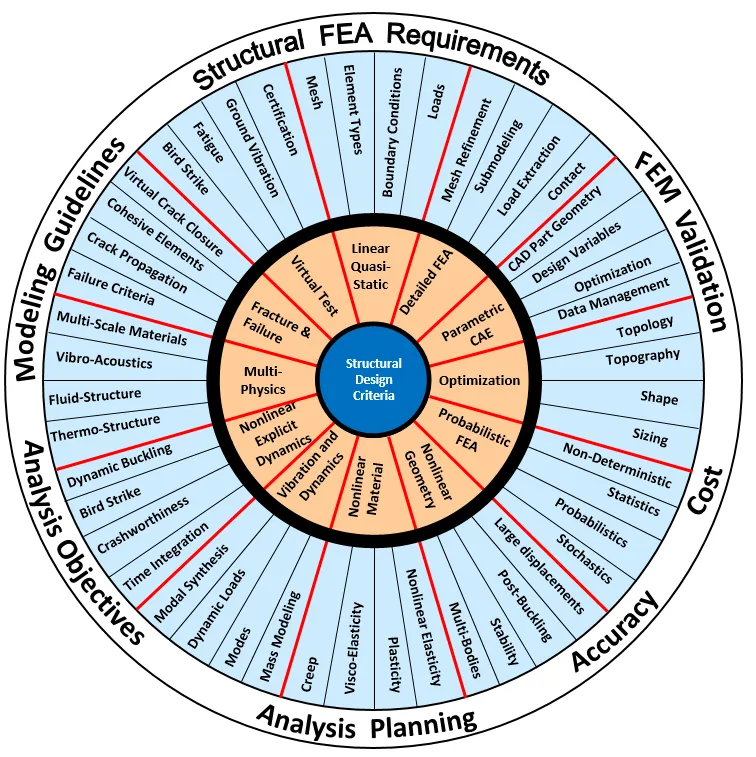
The wheel is a useful map for planning your learning. No one masters every segment at once. Start at the center, with linear quasi-static analysis and the fundamentals of meshing, boundary conditions and loads, then move outward as your projects require it.
The five advantages of learning FEA
1. Learning FEA lets you solve complex problems
The main advantage of learning FEA is that you can solve problems that are impossible to calculate otherwise. Hand calculations are only valid and accurate for very simple problems, and as a mechanical or structural engineer you will rarely face simple problems. Advanced designs are so complex that classical methods will not allow you to meet your objectives.
2. Learning FEA gives you an edge over other engineers
Instead of using conservative assumptions to make an inaccurate hand calculation work, you can use FEA to capture the real failure modes and to compute the critical parts of your design in many different configurations. With FEA, you can also solve problems driven by many different phenomena: elasticity, vibration, stability, plasticity, interaction between parts and more. By mastering FEA, you will develop better products for a fraction of the cost and time.

3. Learning FEA in detail helps you avoid its dark side
Yes, FEA has a dark side. The first aspect is that errors are very difficult to find in complex models. Learning the verification process helps you keep control of your models and gives you greater confidence in the results. The second aspect is that FEA can be used to "prove" wrong results by making bad assumptions. During my career, I have seen very professional presentations based on incorrect analyses that convinced their audience the results were correct. By learning FEA in detail and mastering the modeling techniques, you will avoid these pitfalls and become a better analyst.

4. FEA improves your versatility
FEA is flexible enough to be used in a great variety of applications, and an engineer with a very good knowledge of FEA is much more versatile than one without it. Since modeling techniques are universal, mastering FEA allows you to move between industries and to work on different projects all over the world.

5. Everybody can learn FEA
Finally, everybody can learn FEA. Follow the three stages in the right order, and please do not skip Stage 2: learn the modeling techniques before you learn the software.

The last thing I want to share is that with FEA, you never stop learning. That is the beauty of this discipline. For me, learning something new is the most pleasant feeling of every day. It is not a question of being right or wrong; it is a matter of being open-minded and having enough humility to admit that we cannot know everything.
Key takeaways
- Learn FEA in three stages, in this order: basic theory, modeling techniques, then software. Do not skip the modeling techniques.
- The main danger of FEA is not knowing whether the answer is correct. Your engineering judgment is your best defense.
- An FE analyst must master thirteen skills, from defining a strategy and meshing to validation, documentation and best practices.
- Start with simple problems, practice constantly, learn from your peers and be patient: count on about three years for the basics and five more for advanced knowledge.
- Learning FEA lets you solve complex problems, gives you an edge, protects you from its dark side, makes you more versatile, and is within everyone's reach.
If you are new to the topic, start with the first article in this series, What is FEA?, then continue with Working with FEA.
Go further
This article is based on Lecture 3 of the on-demand course Practical Basic FEA and on Chapter 3 of Practical Finite Element Analysis for Mechanical Engineers by Dominique Madier.
See the Practical Basic FEA course Take the free FEA diagnostic