Free FEA guidelines

Guides, white papers, a workshop and a MasterClass written by Dominique Madier to help you build reliable finite element models. Every guideline is free to download.

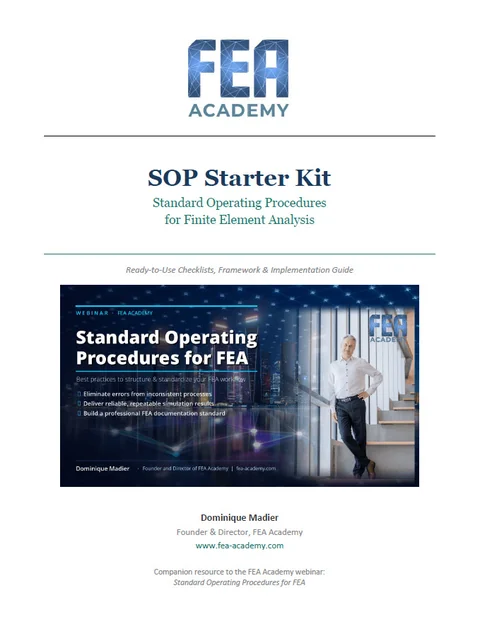
First page of The SOP Starter Kit

Kit · PDF · 14 pages

The SOP Starter Kit

Standard operating procedures turn good intentions into a repeatable process. The SOP Starter Kit is the companion to the FEA Academy webinar on standard operating procedures for finite element analysis, and turns it into a practical toolkit for individual engineers and for team leads who set standards for a group.

It presents a six-stage SOP framework, from model creation, material data, loads and boundary conditions and meshing to solving and result interpretation, with a printable checklist for each stage. You also get the top 10 common FEA mistakes with the SOP that prevents each one, a six-step roadmap to implement SOPs in your organization, and blank templates to track SOPs at project level.
Download the PDF

Video: FEA Insight - Ep #13 - Standard Operating Procedures (SOP) in FEA
First page of Good Modeling Practices

White paper · PDF · about 25 pages

Good Modeling Practices

Many FEA errors do not come from the software but from modeling choices made before the first run. This white paper summarizes 25 good modeling practices for finite element analysis, covering planning, geometry, element selection, meshing, boundary conditions, contact, materials and result checking.

It is written for analysts, engineers and students who want to understand the physics and the decisions behind a simulation instead of treating FEA as a black box. It closes with a list of 25 common FEA mistakes and a three-stage view of how to learn FEA.

Download the PDF

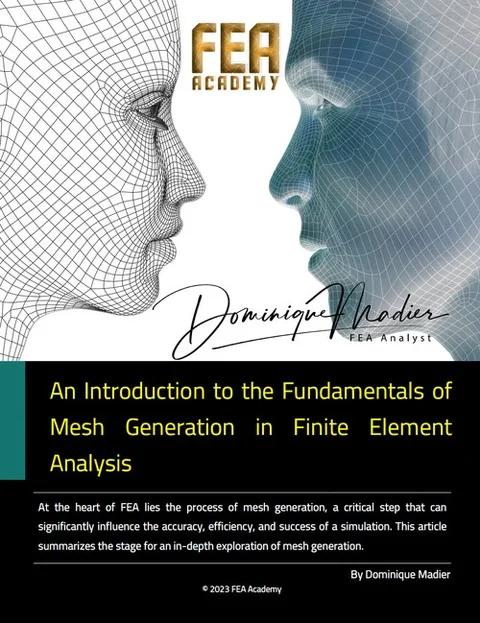
First page of The Fundamentals of Mesh Generation in Finite Element Analysis

E-book · PDF · 64 pages

The Fundamentals of Mesh Generation in Finite Element Analysis

Meshing is where a continuous structure becomes a finite set of elements, and where many analyses gain or lose their accuracy. This e-book covers the fundamentals of mesh generation: what a mesh is, the main generation techniques, how to choose mesh density and element size, refinement techniques, common pitfalls, and how to validate a mesh and check it for errors.

It ends with practical guidelines for effective mesh generation and a convergence study methodology, drawn from 25 years of aerospace consulting. It is useful both to engineers starting with FEA and to experienced analysts who want a structured reference.

Download the PDF

First page of The FEA Process

Guide · PDF

The FEA Process

This guide summarizes the finite element analysis process: the sequence of steps every analysis follows, from the definition of the problem to the interpretation of the results. Use it as a quick reference to make sure no step is skipped in your own analyses.

For a detailed explanation of the process from the engineer's and the solver's perspectives, read the article Working with FEA.

Download the PDF

First page of The Finite Element Method Theory in Depth

Guide · PDF · about 150 pages

The Finite Element Method Theory in Depth

Most engineers use commercial FEA software without seeing what the solver does internally. This guide explains the theory behind the finite element method step by step, starting from simple 1D spring and truss elements and progressing to beam, 2D, plate, shell and 3D solid elements.

It covers the equilibrium equation, the displacement method, the principle of minimum potential energy, element stiffness matrices, matrix assembly and the solution of the equations, with derivations that show where each formula comes from. It is written for mechanical engineers, especially beginners, who want to understand what happens behind the buttons.

Download the PDF

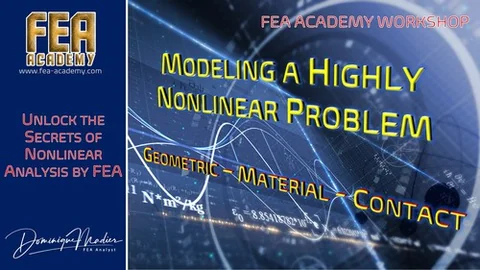
First page of Workshop: Modeling a Highly Nonlinear Problem

Workshop · PowerPoint show

Workshop: Modeling a Highly Nonlinear Problem

Unlock the secrets of nonlinear analysis by FEA. This workshop applies nonlinear FEA to a real benchmark: the punch forming of an aluminum 6111-T4 sheet in a die, a free bending test presented by the Alcoa Technical Center at the Numisheet 2002 conference. The problem is highly nonlinear because it combines the three types of nonlinearity: large displacements (geometric), plasticity (material) and frictional contact between the sheet, the punch and the die (boundary).

After a reminder of how nonlinear solvers work (gradual loading, Newton-Raphson iterations and convergence tests), the workshop builds the simulation step by step: geometry, shell mesh, elastic-plastic material with Hollomon hardening, boundary conditions, contact pairs with friction, the punch in, punch maintained and punch out load sequence, and the nonlinear parameters. The predicted springback angle of 56.1° compares with measured values between 53.4° and 55.8°. It ends with practical modeling tips for very local contact and for the unloading phase.

The workshop is provided as a PowerPoint show. The simulation was run with Nastran, but the modeling techniques apply to any FEA solver. Watch the FEA Insight episode below for the presentation of the workshop.

Download the slides

Video: FEA Insight - Ep #10 - Workshop: Modeling a Highly Nonlinear Problem
First page of Preparing an FEA Interview

MasterClass · PDF · about 55 pages

Preparing an FEA Interview

Preparing for an FEA job interview? This MasterClass gathers the 50 questions most frequently asked in finite element analysis interviews, collected from industry interviewers. Each question comes with a suggested answer and a reference to the matching chapter of Practical Finite Element Analysis for Mechanical Engineers, so you can go deeper on any topic.

The guide closes with practical interview tips on researching the company, making a good first impression and following up. It is written for students and engineers applying for FEA positions.

Download the PDF

Learn the methods behind the models

Our on-demand courses teach the practical modeling techniques used in these examples, step by step.