
Simulation is everywhere. The weather forecast you checked this morning is the result of a simulation. The car you drive was crashed hundreds of times in a computer before the first prototype was built. Pilots train in flight simulators, surgeons rehearse operations on virtual patients, and the aircraft you board was certified with the help of thousands of finite element analyses. Simulation has become so common that we rarely stop to ask what it actually is.
This article answers that question. It explains what a model is, how a simulation differs from a model, when simulation is the right tool, where it is used, and which issues determine whether a simulation can be trusted. Finite element analysis, the subject of most articles on this site, is one particular kind of simulation. Understanding simulation in general helps to understand why FEA works, and why it sometimes does not.
Everything starts with a model
Every simulation is built on a model, so it makes sense to start there.
The conceptual model
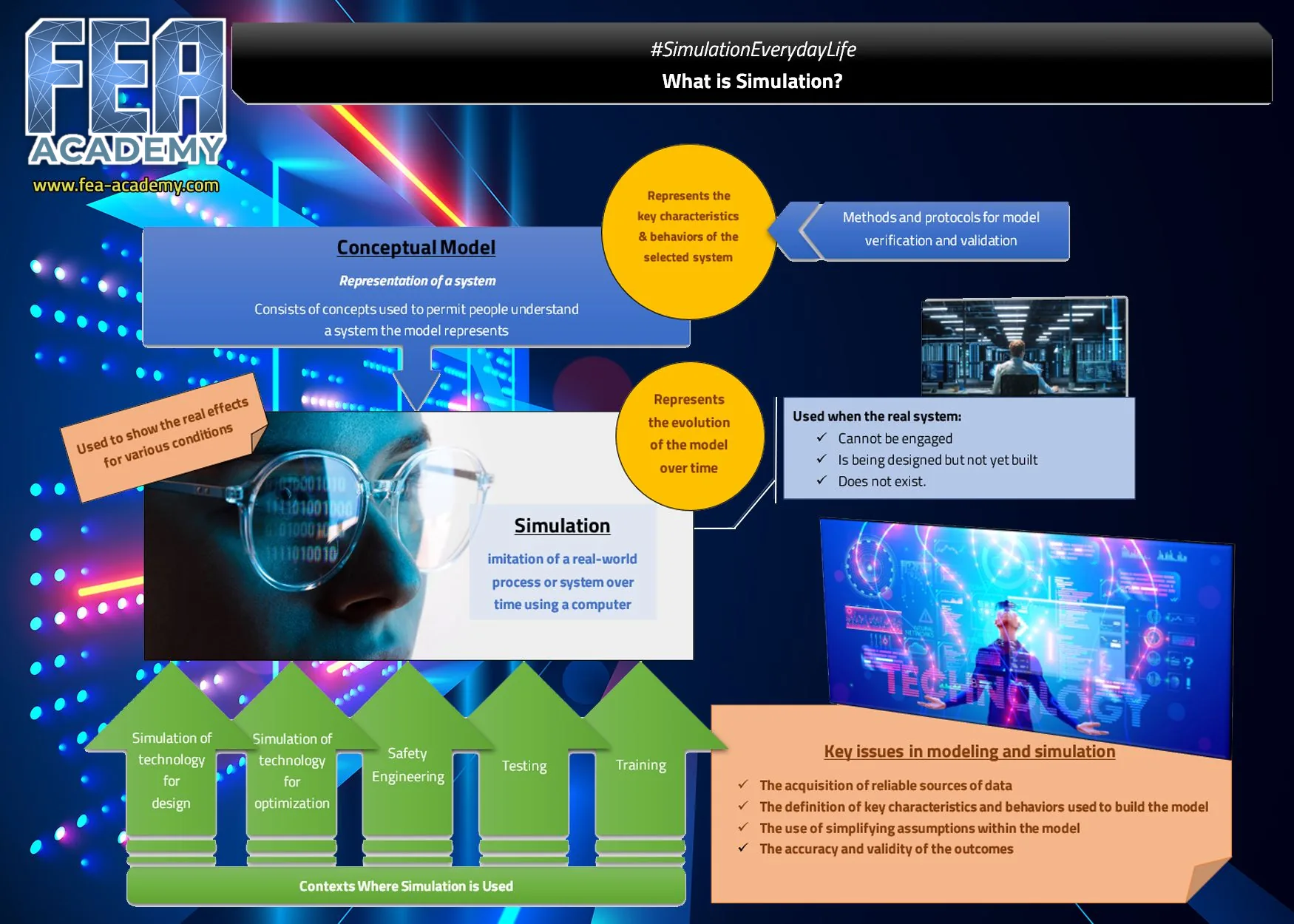
A conceptual model is a representation of a system. It consists of the concepts that allow people to understand the system the model represents. Before any equation is written or any software is opened, someone has to decide what the system is, where its boundaries are, which parts of it matter, and how those parts interact.
Consider a bridge. Its conceptual model might say: the bridge is a steel truss supported at both ends; it carries its own weight, the weight of traffic and the force of the wind; we are interested in the deflection at mid-span and the forces in the members. That short description already contains many decisions. It ignores the foundations, the temperature, the corrosion of the steel, the paint, the people walking on it. These decisions are not mistakes. They are what makes a model useful: a model that included everything would be as complex as the bridge itself, and just as difficult to understand.
The conceptual model represents the key characteristics and behaviors of the selected system. Its quality depends on choosing the right ones. A model of the bridge for a static strength check does not need the same characteristics as a model for a study of wind-induced oscillations, even though the bridge is the same.
From the conceptual model to a computational model
To be simulated, the conceptual model must be translated into a form that can be computed. In engineering, this usually happens in two steps:
- The mathematical model expresses the conceptual model in equations: equilibrium equations, constitutive laws for the materials, compatibility conditions, boundary conditions and initial conditions.
- The numerical model approximates the mathematical model so that a computer can solve it. Finite element analysis does exactly this: it divides the structure into elements and replaces the differential equations by a system of algebraic equations.
At each step, approximations are introduced. The conceptual model simplifies reality, the mathematical model idealizes the conceptual model, and the numerical model approximates the mathematical model. Each layer of approximation is a potential source of error, and each one must be checked.
Verification and validation
This is why the conceptual model comes with methods and protocols for model verification and validation. These two activities, often abbreviated V&V, are the foundation of trust in any simulation:
- Verification checks that the computational model correctly solves the mathematical model. It answers the question: are we solving the equations right? It includes checking the code, checking convergence and comparing results with known solutions.
- Validation checks that the model represents reality with sufficient accuracy for its intended use. It answers the question: are we solving the right equations? It requires comparison with experiments or observations of the real system.
A simulation that has not been verified may contain numerical errors. A simulation that has not been validated may solve the wrong problem very precisely. Both are needed before a simulation can support an important decision.
What simulation is
An imitation over time
A model is a representation of a system. A simulation is the imitation of a real-world process or system over time, using a computer. Where the model describes the system, the simulation makes it act: it represents the evolution of the model over time.
The idea of time deserves some attention. In many simulations, time is explicit: a crash simulation follows the deformation of a car over a few hundred milliseconds, a weather simulation follows the atmosphere over days, a fatigue simulation follows a structure over millions of load cycles. In other simulations, time is replaced by a load parameter: a nonlinear static analysis follows a structure as the load increases step by step, which is also a kind of evolution. Even a linear static analysis, which computes a single equilibrium state, can be seen as the end point of a process: the structure under its final load.
Running a model over time, under different conditions, is what gives simulation its power. The model can be loaded, heated, shaken, broken and repaired as many times as needed, and each run shows how the system responds.
Showing real effects under various conditions
Simulation is used to show the real effects of various conditions on a system. What happens to the bridge when a truck crosses it? When the wind blows at 100 km/h? When a cable breaks? When the temperature drops to minus 30 degrees? Each question becomes a simulation run, and each run gives an answer that would be expensive, dangerous or impossible to obtain from the real system.
This ability to change the conditions and observe the effects is what distinguishes simulation from simple calculation. A calculation answers one question. A simulation is a laboratory in which many questions can be asked.
When simulation is used
Simulation is not always the best tool. When the real system is available, safe to experiment with and cheap to test, a physical experiment may be simpler and more convincing. Simulation becomes the right tool when the real system:
- cannot be engaged: it is too dangerous, too expensive, too large or too slow to experiment with. Nobody tests the collapse of a nuclear containment building, the failure of a dam or the behavior of an aircraft in a bird strike at full scale without first simulating it.
- is being designed but is not yet built: during development, the system exists only as drawings and models. Simulation is the only way to evaluate its behavior before committing to manufacturing.
- does not exist: some systems will never be built in the form being studied, such as alternative concepts, hypothetical scenarios, future conditions or systems that are not physically accessible.
In engineering, the second case is the most common. Simulation allows the behavior of a product to be predicted while it can still be changed easily and cheaply. A design change in a finite element model costs minutes; the same change in tooling or in a built prototype can cost months.
Contexts where simulation is used
Simulation supports many activities. In engineering, five contexts stand out.
Simulation of technology for design
During design, simulation predicts how a product will behave and whether it meets its requirements. Structural analysis checks strength and stiffness, thermal analysis checks temperatures, fluid dynamics checks flows and pressures. The designer uses the results to choose between concepts, to size components, and to identify problems before they reach the prototype stage.
Simulation of technology for optimization
Once a design works, simulation helps to make it better: lighter, cheaper, stronger or more efficient. Optimization algorithms can run thousands of simulations to explore a design space that no engineer could explore by hand. Topology optimization, for example, finds the most efficient distribution of material in a part, often producing shapes that a designer would not have imagined.
Safety engineering
Simulation is a key tool for safety. It predicts how systems behave under accidental or extreme conditions: crashes, impacts, explosions, earthquakes, fires and failures. It allows engineers to study scenarios that must never happen in reality, and to design systems that protect people when they do.
Testing
Simulation and testing are partners, not competitors. Simulation is used to plan tests, to choose the instrumentation and to predict the results. Tests are used to validate simulations. Once validated, simulations can reduce the number of tests, extend test results to other configurations, and in some industries support certification by analysis.
Training
Simulation trains people as well as designs products. Flight simulators, driving simulators, surgical simulators and process control simulators let people practice in realistic conditions without risk. The same principle applies to the engineering analyst: running simulations, comparing them with reality and understanding the differences is one of the best ways to build engineering judgment.
Key issues in modeling and simulation
Simulation is powerful, but it is not magic. Its results are only as good as the model behind them. Four key issues determine whether a simulation can be trusted.
1. The acquisition of reliable sources of data
A simulation needs data: geometry, material properties, loads, boundary conditions, initial conditions. If the data is wrong, the simulation will be wrong, however sophisticated the software. This is the famous principle of "garbage in, garbage out".
Reliable data comes from recognized sources: material handbooks and databases, supplier certificates, measurements, previous validated analyses. Its origin should be documented, its uncertainty known, and its range of validity respected. A material property measured at room temperature does not describe the material at 300 degrees, and a load measured on one aircraft does not necessarily apply to another.
2. The definition of key characteristics and behaviors used to build the model
The model must include the characteristics and behaviors that matter for the question being asked, and only those. Leaving out an important behavior, such as plasticity in a part that yields, contact in an assembly that separates, or damping in a structure near resonance, makes the simulation wrong. Including too much makes it slow, fragile and difficult to check.
Choosing the key characteristics is an engineering decision that requires understanding the physics of the problem. It is also the decision that software cannot make for you.
3. The use of simplifying assumptions within the model
Every model simplifies. Geometries are cleaned, materials are idealized, supports are represented by constraints, loads by forces and pressures. These simplifications are necessary, but each one introduces a difference between the model and reality.
The right approach is to make simplifying assumptions consciously, to write them down, and to check their effect. Does removing this fillet change the stress at the point of interest? Does the result change if the support is flexible instead of rigid? A simulation whose assumptions are documented and checked can be trusted within its limits. A simulation whose assumptions are hidden in software defaults cannot.
4. The accuracy and validity of the outcomes
Finally, the results themselves must be assessed. Are they accurate, meaning close enough to the exact solution of the model? Are they valid, meaning representative of the real system for the intended use? Accuracy is checked through verification activities such as convergence studies and comparison with known solutions. Validity is checked through comparison with tests and observations.
Results should also be reported with their limitations. A stress predicted by a simulation is not a single exact number; it is an estimate with an uncertainty that depends on the data, the model and the method. Communicating that uncertainty is part of the job.
Simulation and finite element analysis
Finite element analysis fits naturally into this framework. The conceptual model defines the structure, its loads and its supports. The mathematical model expresses them as the partial differential equations of solid mechanics. The finite element method turns these equations into a numerical model that the computer can solve. Verification checks the mesh and the solution; validation compares the predictions with tests. The key issues of simulation, reliable data, the right characteristics, conscious assumptions, accurate and valid outcomes, are exactly the issues that determine the quality of an FEA.
Seeing FEA as one form of simulation also explains why the skills of a good analyst go beyond the software. Building a mesh is one step. Deciding what to model, with which data and which assumptions, and how to check the results, is the work of simulation.
Conclusion
Simulation is the imitation of a real-world process or system over time, using a computer. It is built on a conceptual model that represents the key characteristics and behaviors of a system, translated into mathematical and numerical models, and checked through verification and validation. It is used when the real system cannot be engaged, is being designed but not yet built, or does not exist, and it supports design, optimization, safety engineering, testing and training.
Its value depends on four issues: reliable data, the right characteristics and behaviors, conscious simplifying assumptions, and accurate and valid outcomes. Master these, and simulation becomes one of the most powerful tools an engineer can use. Neglect them, and it becomes a fast way to produce convincing but wrong answers. The next article, Why Use Simulation?, looks at the benefits that make simulation worth the effort.
Go further
Learn FEA with a structured path: the on-demand course Practical Basic FEA covers the fundamentals step by step, and Practical Finite Element Analysis for Mechanical Engineers by Dominique Madier gathers the best modeling practices in one book.
See the Practical Basic FEA course Take the free FEA diagnostic