
Nonlinear analyses do not always converge, and when they fail, finding the cause can be frustrating. This third part of the nonlinear static analysis series gives the key points to manage convergence problems and the eight most common mistakes to avoid in nonlinear analysis.

Managing convergence problems
If the solver does not obtain convergence, the last load step is automatically reduced through cutbacks. The program stops if the load increment becomes too small, or if the convergence problems persist after several cutbacks of the load increment.
When the program stops, look at the solver log file in the increments before the final error message. You will see warnings that tell you what kind of convergence problem occurred, such as:
- The residual force is too large.
- The contact algorithm did not converge.
- The load increments are too large.
Look at the last converged load increment: large changes in some quantity frequently indicate the location of the problem.
If the first load increment does not converge, set the size of the first increment to a very small value. If the problem persists, the model itself is unstable, because of:
- Missing boundary conditions
- An initial overlap of contacting surfaces
To find the cause of the convergence problem, simplify your model step by step:
- Make sure the model is properly constrained (all rigid body motions must be removed).
- Use simpler material laws (elasticity instead of plasticity, for example).
- Switch off geometric nonlinearity.
- Remove the external loads step by step.
Common mistakes in nonlinear analysis
Mistake 1: insufficient system resources
- Make sure your system has enough memory (RAM).
- Ensure your system also has enough hard disk space: the result files of a nonlinear analysis are usually large.
Mistake 2: a wrongly defined FEM
The model geometry, loadings, boundary conditions and contact definitions must be verified.
- Perform a complete verification process (accuracy checks and mathematical checks).
- Run a linear static analysis and a linear buckling analysis before running the nonlinear analysis.
- The solution settings are also crucial.
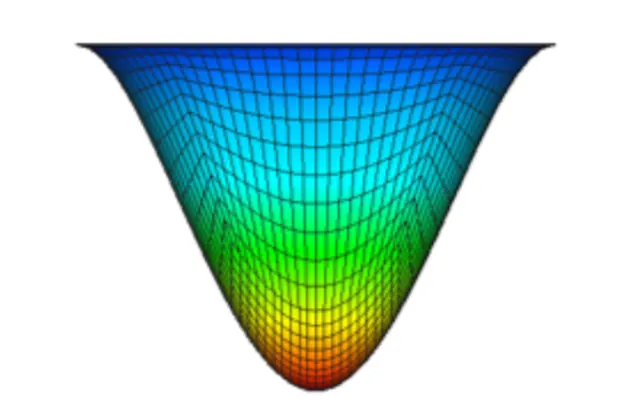
Mistake 3: geometric nonlinearity not activated
- FEA software requires a setting somewhere in the analysis definition to activate geometric nonlinearity.
- Unlike material nonlinearity, which is defined in the material properties, geometric nonlinearity is easy to forget. The mistake is also harder to find, because its effect is more subtle than that of material nonlinearity.

Mistake 4: material nonlinearity not activated
This mistake is easy to catch, because it is usually very apparent in the results.

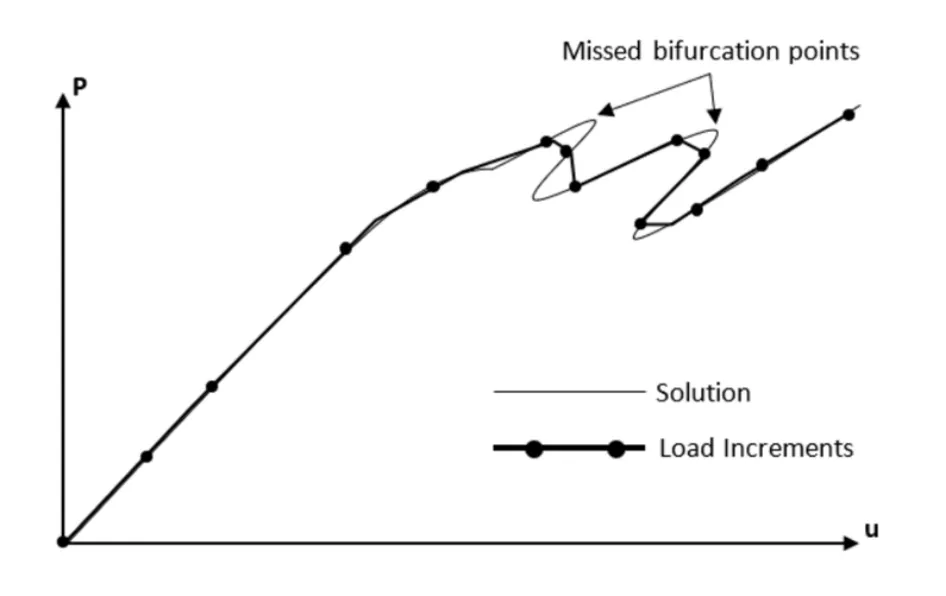
Mistake 5: wrongly defined load increments
- This mistake can occur in any analysis.
- Its impact is greater if the equilibrium path exhibits drastic changes.
- If your load increment is too large, you can miss a bifurcation point and overestimate the capacity of your system.
Mistake 6: too few iterations allowed per load increment
If the maximum number of iterations per load increment is too low, the solver may not converge, and the analysis will stop before reaching the point of interest. Typical rules:
- For weakly nonlinear problems: allow at least 25 iterations per load increment.
- For highly nonlinear problems: allow at least 100 iterations per load increment.

Mistake 7: overly tight convergence criteria
Do not define convergence criteria that are too tight. FEA software provides typical convergence criteria, depending on the type of problem and the required accuracy. It does not make sense to ask for convergence criteria around 10−5 when an engineering problem generally gives very accurate results with convergence criteria of 10−2.
Mistake 8: incorrect mesh and/or element type
- The mesh and the element type can strongly influence the results.
- Always refine the critical regions and use elements with nonlinear capabilities.
- Severely distorted elements produce fatal error messages.
Start from the beginning of the series with part 1: what makes a system nonlinear.
Go further
This Book Byte is taken from Chapter 21 of Practical Finite Element Analysis for Mechanical Engineers by Dominique Madier. The topic is covered in depth, with worked examples, in the on-demand course Practical Nonlinear FEA.
See the Practical Nonlinear FEA course Take the free FEA diagnostic