
Submodeling lets you obtain an accurate local solution without refining the whole model. This Book Byte defines the global and local models, explains why Saint-Venant's principle makes submodeling valid, why it saves computing time, the two methods used in practice, and six tips to submodel correctly.
What is submodeling?
Submodeling is a modeling technique used to compute a refined solution from a previous coarse analysis. It uses two separate models:
- A coarse model
- A refined model
The results from the coarse model are used as boundary conditions and mapped onto the refined model.
Definitions
Coarse model: the global FEM (GFEM), also called the load model.
- Models the global stiffness of a structure to determine the load distribution in its different parts.
- Captures the internal loads and the interface loads.
- Does not capture the local effects that may occur in the structure.
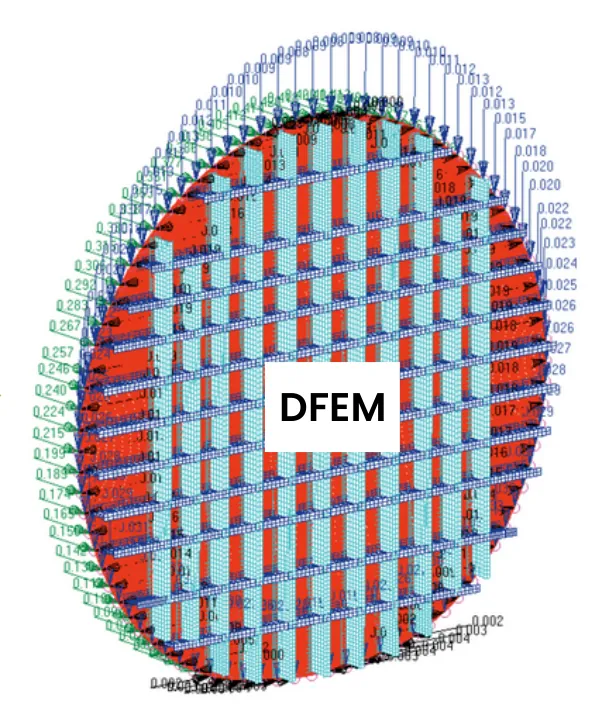
Local model: the detailed FEM (DFEM), also called the submodel.
- A refined model that includes local features that may have been omitted from the global model.
- Captures the local behaviors not captured by the GFEM.
- Enables the analyst to properly predict the stresses and strains in the structure, or the behavior of a joint.
Reminder: Saint-Venant's principle
"The difference between the effects of two different but statically equivalent loads becomes very small at sufficiently large distances from load."
Adhémar Jean Claude Barré de Saint-Venant (1797 to 1886).
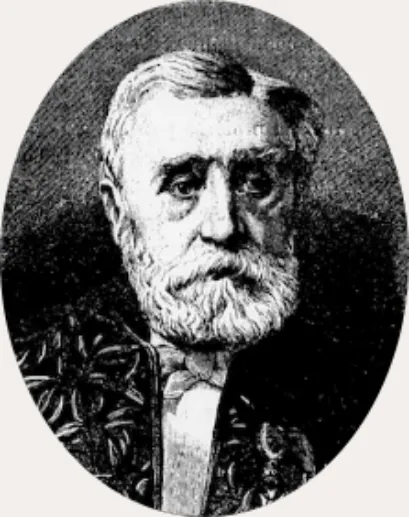
If the submodel boundaries are far enough from the region of interest, reasonably accurate results can be obtained with the submodel.
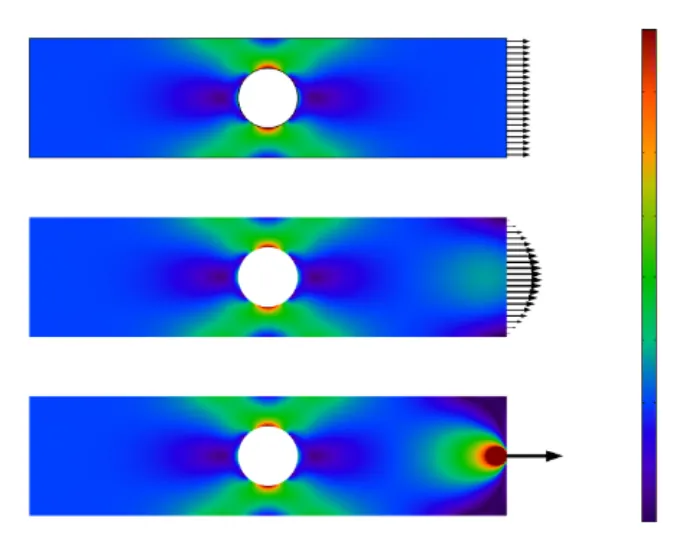
In the plate example below, the zone of interest is the region around the hole. The stress distribution at the hole is not affected by how the load is applied, because the three applied loads are statically equivalent and the hole is far enough from the load. Only the region close to the applied load reacts differently, and it is not the zone of interest.
Why do submodeling?
The goal is to obtain more accurate results in a particular region of the model, without the need to refine the whole model.
- Global models are large, with a significant number of degrees of freedom.
- Submodeling lets you refine the model only in the region of interest to capture local effects.
- This local refinement increases the number of degrees of freedom by a reasonable amount, while keeping an acceptable computing time and memory consumption.
Computing time and the number of degrees of freedom
The computing time is directly proportional to the square of the number of degrees of freedom in your model. The finer the mesh, the longer the computing time, but also the greater the accuracy of the solution. You must therefore find a balance between accuracy and computing time.
It does not make sense to increase the computing time by a factor of 2 or 3 to improve the accuracy by only 1%. The key is to know your problem well, to achieve accuracy where it is necessary. Submodeling helps because it lets you put the DOFs only where you need them.
How to do submodeling
Method 1: submodel within the global FEM
- Refine a critical region of the global model and create a transition mesh between the refined region and the rest of the global model.
- The submodel is directly loaded, which is advantageous when several load cases must be analyzed.
- The displacement or force fields at the interface do not need to be extracted from the GFEM and reapplied to the submodel.
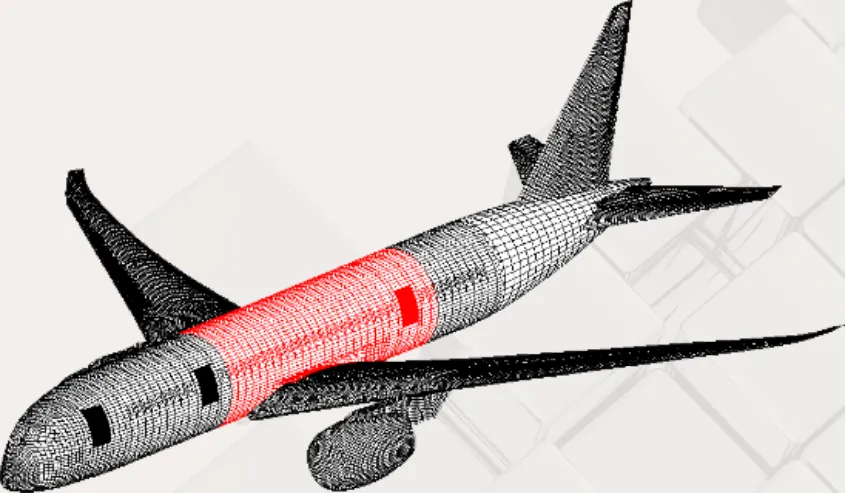
Method 2: extract a part of the global FEM
- Extract the region of interest from the global model and refine it as needed.
- Then, extract the displacement or force fields from the global model and apply them to the local model as boundary conditions.
- Repeat the process for each critical load case.
- Usually, the global model results are surveyed to identify a few critical cases, and the field extraction is limited to these cases.
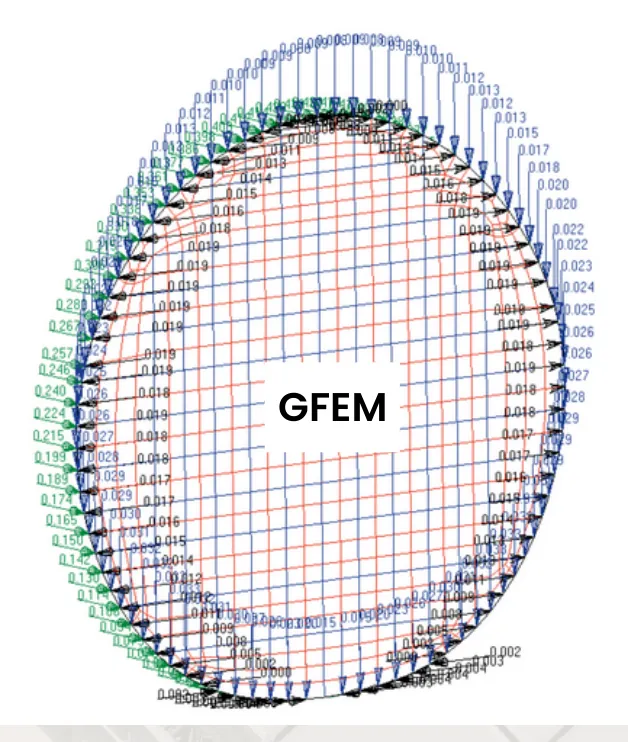
Free-body displacements or forces are extracted for each loading condition at each GFEM interface node, then applied to a standalone DFEM.
Six tips for submodeling
- If temperature and/or pressure are applied to the global model, don't forget to apply them to the submodel.
- Do not change the material properties in the refined region: you only seek to capture a local effect with greater refinement, and the two models must remain statically equivalent.
- Submodeling assumes that the refined region is far enough from boundary effects (constraints or loads).
- You can submodel several regions of the global model.
- You can submodel a submodel.
- After running the submodel, verify that the displacement fields of the global model and the submodel are compatible.
Go further
This Book Byte is taken from Chapter 15 of Practical Finite Element Analysis for Mechanical Engineers by Dominique Madier. The topic is covered in depth, with worked examples, in the on-demand course Practical Basic FEA.
See the Practical Basic FEA course Take the free FEA diagnostic