
A reliable finite element analysis starts long before the first element is created. This Book Byte explains why planning is the first step of any good FEA, the ten steps to follow to build an FEA strategy, and the fourteen questions you should be able to answer before you begin modeling.

It all starts with a good plan

Developing an FEM is like playing chess
You must anticipate problems, predict behavior and adapt your strategy. The first step in developing a good FEA is planning.

True FEA is about understanding the real behavior of a structure by being able to reproduce this behavior with a computer. At all stages of the simulation process, keep in mind that we are solving real problems.
As FEA analysts, we must understand the factors and assumptions that most influence the results, to ensure they are accurate. To achieve our objectives, we must develop our own strategies and use FEA software simply as a tool to help solve complex problems we would otherwise not be able to solve.
In summary, we should not allow the FEA software to control our analysis. The key is to plan the modeling process, anticipate the problems and results, and prioritize engineering judgment as our preferred tool to guide the simulation.
FEA is a powerful tool for solving very complex problems, but it takes time to produce a robust and reliable FEA.
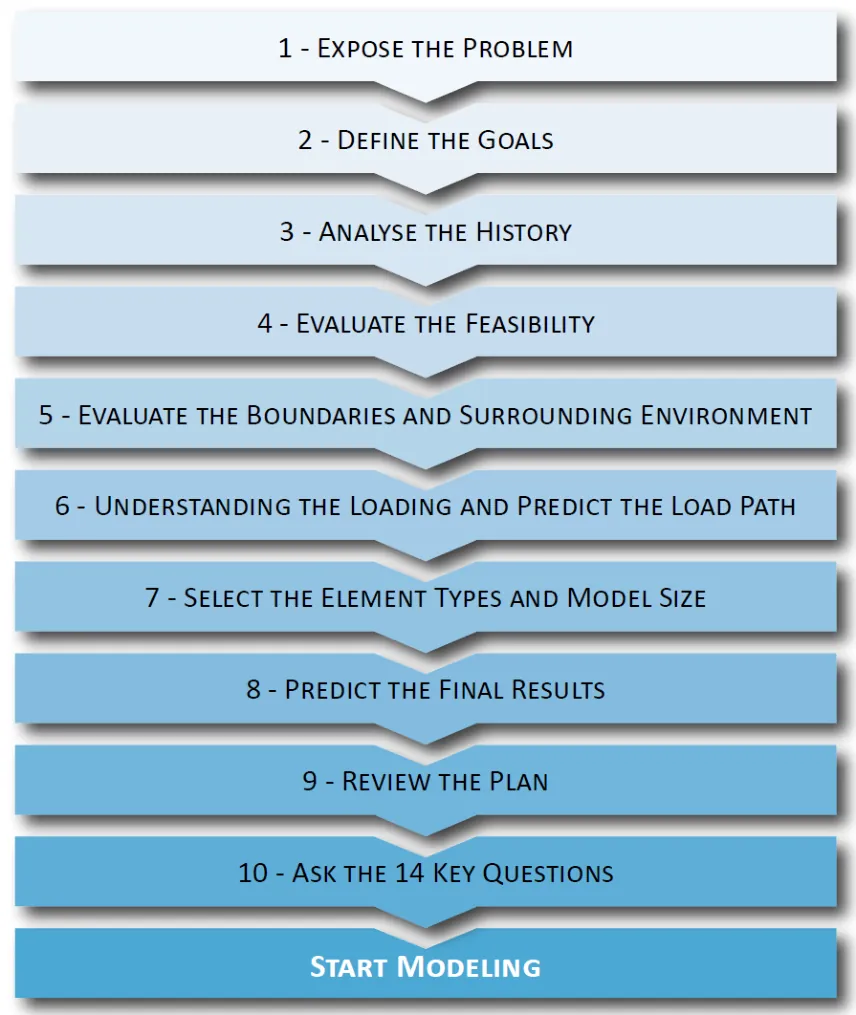
The 10 steps to build an FEA strategy
- Expose the problem.
- Define the goals.
- Analyze the history.
- Evaluate the feasibility.
- Evaluate the boundaries and surrounding environment.
- Understand the loading and predict the load path.
- Select the element types and model size.
- Predict the final results.
- Review the plan.
- Ask the 14 key questions.
Then, and only then, start modeling. Each step is detailed in Chapter 6 of the book Practical Finite Element Analysis for Mechanical Engineers.
The 14 questions to answer before you begin modeling
- Have you clearly identified the model's goals?
- Which solution do you plan to use, and is it consistent with your problem?
- Do you trust the geometry you plan to use, and can you change it if necessary?
- Can you justify your choice of elements?
- Which boundary conditions will you apply to your model? Why did you select them?
- Do you fully understand the loading you will apply to your model?
- Have you identified the major load paths in your structure?
- Are you able to anticipate the response of your structure?
- At which locations in the model do you plan to extract results?
- What accuracy of results do you require?
- Have you identified all the modeling techniques you will use to build your model?
- Have you identified the discontinuities in the structure you wish to model?
- Have you identified all the capabilities and limitations of your model?
- Do you expect any potential sources of nonlinearity?

Do not start the modeling process
If you cannot answer all of these questions, do not start the modeling process.
Go further
This Book Byte is taken from Chapter 6 of Practical Finite Element Analysis for Mechanical Engineers by Dominique Madier. The topic is covered in depth, with worked examples, in the on-demand course Practical Basic FEA.
See the Practical Basic FEA course Take the free FEA diagnostic